
Moisture and Contaminant Risk Indices in Data Centers: Applying Mold Risk Methodologies
Abstract
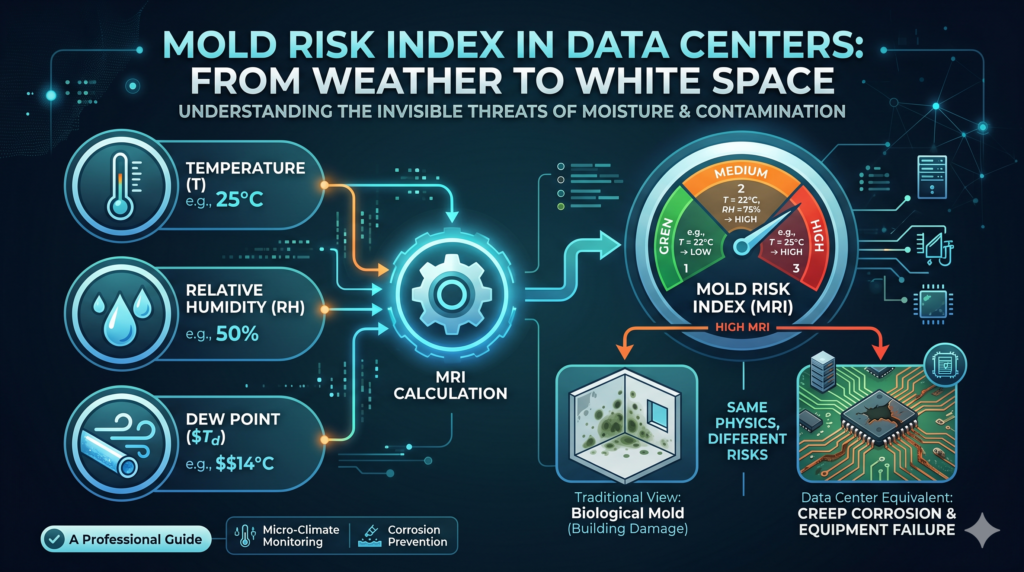
The relationship between Relative Humidity (RH), Temperature (T), and Dew Point (DP) governs biological mold growth. In data centers, these exact parameters also drive condensation, hygroscopic dust formation, and creep corrosion on Printed Circuit Boards (PCBs). This paper outlines how facilities can adapt the Mold Risk Index (MRI) into a comprehensive Environmental Risk Index using continuous monitoring technologies, such as AKCP’s Air Quality and Environmental Sensors.
1. Understanding the Mold Risk Index (MRI)
The MRI calculates the probability of mold growth on surfaces. It relies on four primary variables:
- Air Temperature (Ta)
- Relative Humidity (RH)
- Dew Point (Td)
- Surface Temperature (Ts)
The critical metric is the Dew Point Margin (ΔT), which is the difference between the physical surface temperature and the surrounding air’s dew point:
ΔT = Ts − Td
Condensation occurs as ΔT approaches zero, escalating mold risk. However, biological growth can also begin if the surface RH exceeds 75% for extended periods.
An alternative MRI calculation (valid when RH > 75% and ambient temperatures are between 5°C and 40°C) evaluates the risk percentage directly:
Risk% = (RH − 70 / 30) × 100
2. Relevance to Data Centers: Mold vs. Micro-Corrosion
The physics driving mold growth also cause severe data center threats. The variables are identical; only the failure mechanism changes.
Threat Category | Mechanism | Consequences |
Biological (Facility Integrity) | Condensation forms on raised floors, dropped ceilings, or chilled water lines. | Mold growth on drywall and subfloors; compromised structural integrity; health hazards for personnel. |
Electrochemical (Equipment Integrity) | Moisture interacts with airborne contaminants during humidity spikes or rapid cooling. | Creep corrosion and short circuits on IT equipment. |
The Electrochemical Threats in Detail:
- Hygroscopic Dust: Accumulated airborne dust acts as a thermal insulator. Under high RH, this dust absorbs moisture and turns into a conductive paste, causing short circuits.
- Creep Corrosion: When moisture combines with Volatile Organic Compounds (VOCs) or sulfur gases, it forms acidic compounds that corrode the copper traces and solder joints of electronic boards.
3. Incorporating AKCP Sensor Technology
To mitigate these risks, facilities require comprehensive, real-time environmental monitoring. AKCP provides specific solutions to track these precise variables:
- Mapping the Dew Point Margin: Relying on a single wall thermostat is insufficient. AKCP Thermal Map Sensors provide localized temperature and humidity readings at the front, rear, top, middle, and bottom of server racks. This allows for precise Dew Point calculations at the rack’s intake and exhaust.
- Detecting Catalysts with Air Quality Sensors (AQS): Condensation becomes highly destructive when combined with dust and gases. The AKCP Air Quality Sensor (AQS) monitors particulate matter (PM1.0 to PM10), alongside VOC and NOx indices. Additionally, the compact AQX4 sensor tracks temperature, humidity, static pressure, and a unified air quality index. Spikes in VOCs/NOx or particulates—when paired with rising humidity—instantly flag conditions suitable for creep corrosion.
4. Implementing the Monitoring Solution
Strategic sensor placement is critical for accurate risk assessment and automation.
- Deploy Micro-Climate Sensors: Install temperature and humidity sensors at known cold-spots, such as near CRAC unit outlets, under raised floors, and along exterior walls.
- Establish Air Quality Baselines: Place Air Quality Sensors in the CRAC return air streams to monitor total particulate and gaseous contaminant loads.
- Automate the Risk Index: Utilize platforms like AKCP’s Quicklime DCIM Thermal Optimization Software to process sensor telemetry. The system generates alerts when the mathematical relationship between the dew point, surface temperatures, and VOCs crosses critical thresholds.
5. Conclusion
Translating the MRI into a data center context allows administrators to visualize and proactively manage invisible environmental threats like creep corrosion. Deploying targeted monitoring solutions extends IT infrastructure lifecycles and significantly reduces the risk of downtime.
Beyond risk mitigation, these sensors feed into AKCP’s sensorCFD thermal optimization tool. By utilizing AI reporting to visualize airflow, identify thermal irregularities, and release stranded capacity, data centers can achieve measurable reductions in PUE and overall energy consumption.