How Physical Sensors, Computational Fluid Dynamics, and Artificial Intelligence Can Reduce PUE
I. THE LIMITATIONS OF STATIC CFD MODELS
Static CFD is a vital tool during the design and engineering phases of a data center. It helps with room layout, CRAC/CRAH placement, and establish the baseline cooling requirements. However, static CFD models have several critical limitations once the data center goes live.Furthermore, recent reviews of energy efficiency methodologies emphasize that relying solely on design-phase metrics is insufficient for modern high-density environments, necessitating continuous, real-time evaluation to accurately measure and manage operational PUE [1]
- Static Variables in a Dynamic World. The static model assumes constant IT loads, fixed server fan speeds, and perfectly configured containment. In reality, workloads shift dynamically, hardware is changed, and containment integrity is compromised.
- Worst-Case Design. Because static models cannot adapt to real-time changes, they are designed around maximum theoretical loads. This results in over-provision of cooling to ensure SLA compliance during a “once in 100 year event”.
- Source of Truth. A simulated model is only as good as its inputs. Without ongoing validation, data center managers are unable to verify where the air is reaching, locate hot spots, cold spots, and identify the underlying causes.
II. BRIDGING THE GAP WITH SENSOR DATA
To move beyond the static model, operators must establish a source of truth. This is achieved through deploying a network of sensors across the data center facility.
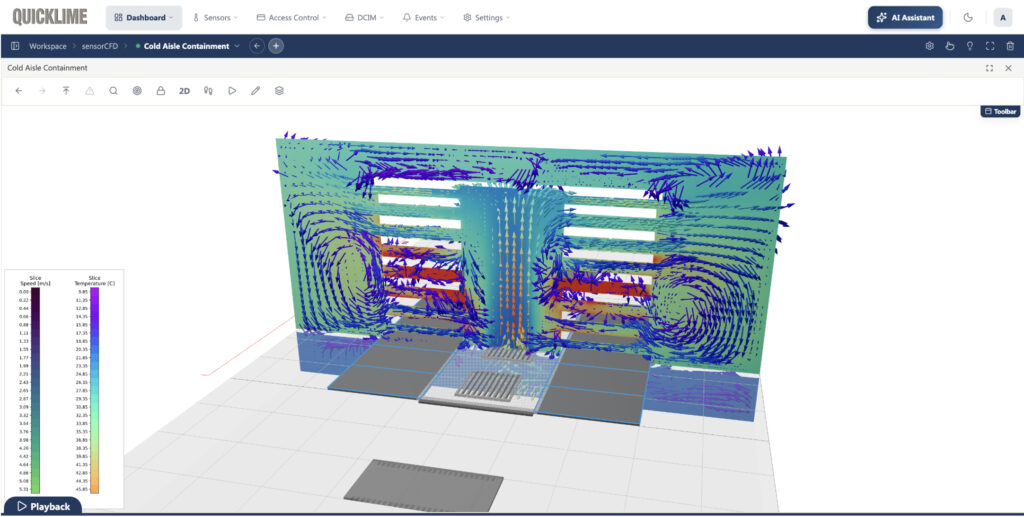
Monitoring room-level ambient temperature, or the cold/hot aisle containment temperature, is no longer sufficient. As the CFD simulation (Fig. 1) illustrates, a temperature sensor in the cold aisle would only identify there is a source of cold air. It does not know anything about the volume of that air and where it is going. There are clearly hotspots and recirculating air issues in this cold aisle containment that need to be addressed. These are only identified by the use of additional sensors.
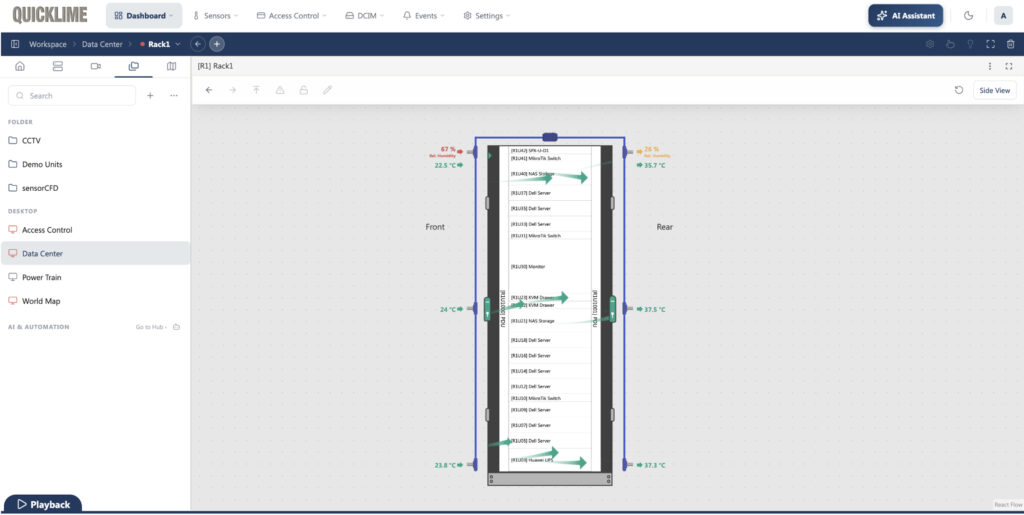
High-density deployments require a higher density of sensors for a detailed understanding of the thermal gradient across individual racks. This is achieved with Cabinet Thermal Map Sensors, which monitor the temperature front and rear, top middle and bottom as well as ∆T (Fig. 2). Other data points such as rack level power is also required. The higher the density of these sensors, the more accurate the CFD model will become.
In addition to rack level sensors, the ∆T and power of the CRAC/CRAH units is necessary, as well as calibration sensors scattered at room level.
This data is collected and sent to a Digital Twin created within the DCIM. No longer are the sensors simply monitoring for thresholds and sending alerts. They transform the Digital Twin from a theoretical model into a measured environment with actionable data. This transition to a data-driven decision-making framework is essential; dense sensor networks allow operators to actively detect shifting thermal anomalies and mitigate localized hot spots before they impact infrastructure reliability [2]
III. NECESSITY OF AIR COOLING IN THE LIQUID ERA
While there has been a rapid shift in modern data center design toward direct-to-chip (D2C) liquid cooling it does not invalidate the need for air based thermal monitoring. Liquid cooling is essential for next-generation architectures, where rack power densities are pushing 100 kW per rack, [3] D2C does not eliminate the need for air cooling [4].
D2C cold plates are deployed to capture heat from critical chips such as GPUs. However, these liquid cooling systems typically extract only about 70% of the total heat produced. [5] The remaining 30% is generated by components that are not subject to D2C including memory modules, voltage regulators, power supplies, and networking equipment.
To put this into perspective, in a modern 100 kW AI rack utilizing D2C liquid cooling, approximately 30 kW of heat must still be rejected by traditional methods. This air cooled load is equivalent to the typical maximum power density of a traditional, fully air-cooled rack. Rather than becoming obsolete, air thermal management and visualization are as important as ever.
Data Center operators must monitor the air passing through these hybrid racks using physical monitoring, like AKCP’s cabinet thermal map sensors. Without this level of operational air monitoring, a facility risks cascading thermal failures across millions of dollars of liquid-cooled AI infrastructure.
IV. SENSORCFD: REAL TIME OPERATIONAL ANALYSIS
The combination of live sensor data and CFD is where PUE efficiency gains are found. AKCP’s patent pending sensorCFD technology takes CFD out of the design phase and integrates it into daily operations.
While the CFD is still a “static snapshot” of the data center, it is based on the real world operational conditions and can be conducted multiple times per day. sensorCFD takes in data from cabinet thermal maps, power meters and calibration sensors to generate a visualization of the data center’s thermal environment.
This approach provides distinct operational advantages:
- Continuous Data:The CFD model is regularly updated with real-world sensor data, ensuring the visualization matches reality.
- Stranded Capacity Identification:By visualizing airflow and temperature distributions in real-time, operators can identify areas where cooling is over-provisioned and safely reclaim stranded capacity.
- Dynamic Response to Anomalies:Containment leaks or sudden workload spikes are visualized, allowing for intervention before downtime occurs.
V. ARTIFICIAL INTELLIGENCE AND PUE REDUCTION
Whereas the sensors provide data, and sensorCFD provides the operational model. AI is the final layer. The output from CFD simulations can be complex (Fig. 3), and still requires interpretation. This is where AI comes in. Acting as a trusted advisor, it is like having a CFD expert on hand 24/7/365.

To be reliable, AI algorithms require accurate, structured data. By feeding the sensorCFD model and the raw sensor data into an AI engine, the DCIM Digital Twin moves from passive monitoring and alerting to active optimization, generating reports with actionable items. By closely integrating these live Digital Twins with advanced AI algorithms, data centers can move beyond manual intervention, safely and dynamically adjusting cooling parameters to achieve substantial, continuous PUE reductions [6]. The human is still in the loop, reviewing the report and taking the action, although as AI improves and trust is established, automation of setpoints and fan speeds could be AI actuated so long as carefully planned harnesses and backstops are in place.
Predictive Cooling Adjustments. The AI can analyze historical trends and real-time CFD data to predict thermal loads before they peak, dynamically adjusting CRAC setpoints and fan speeds with precision
Safe Setpoint Elevation. The easiest way to improve PUE is raising rack inlet temperatures to the upper limits of ASHRAE guidelines. AI, backed by the safety net of cabinet thermal maps, allows operators to incrementally raise temperatures in a safe and controlled manner. The system continuously validates that no individual server is starved of cooling, maximizing PUE while maintaining uptime.
VI. CONCLUSION
While Static CFD is an essential tool for data center design, it is fundamentally unsuited for managing the complexities of an operational data center facility. To achieve reductions in PUE, the industry must move towards dynamic, sensor data driven operations.
By deploying physical sensors data center operators capture the ground truth. By leveraging AKCP’s sensorCFD to create a live thermal model, and applying AI to optimize cooling parameters, data centers can safely eliminate over-provisioning. The result is a highly efficient facility that maximizes compute density while driving cooling costs down.
- Long, Y. Li, J. Huang, Z. Li, and Y. Li, “A review of energy efficiency evaluation technologies in cloud data centers,”Energy and Buildings, vol. 260, p. 111848, 2022.
- Milić, “Next-generation data center energy management: a data-driven decision-making framework,”Frontiers in Energy Research, vol. 12, 2024.
- Wang, Z. Cao, Q. Zhang, et al., “Toward Physics-Informed Machine Learning for Data Center Operations: A Tropical Case Study,”arXiv:2505.19414, 2025. [Online]. Available: https://arxiv.org/abs/2505.19414
- Cao, M. Li, and F. Lin, “Transforming Future Data Center Operations and Management via Physical AI,”arXiv:2504.04982, 2025. [Online]. Available: https://arxiv.org/abs/2504.04982
- A. Ahmad, A. Bartolini, F. Beneventi, et al., “Design of an Energy Aware Petaflops Class High Performance Cluster Based on Power Architecture,”arXiv:2307.05790, 2023. [Online]. Available: https://arxiv.org/abs/2307.05790
- Athavale et al., “Digital Twins for Data Centers,”Computer, vol. 57, pp. 151-158, 2024.
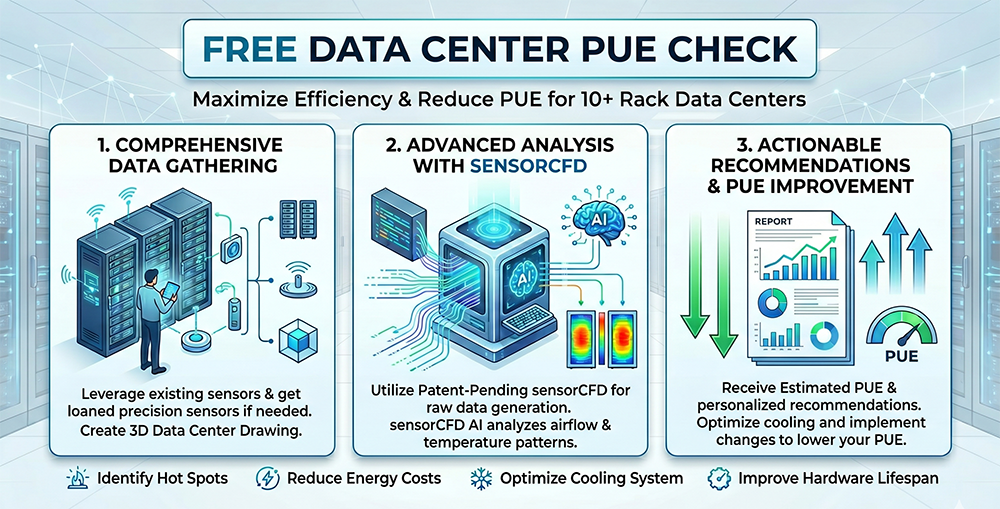
Interested in a FREE data center PUE Health Check? Contact sa***@**cp.com to find out more, or click the link below to schedule a 15 minute consultation.