Pharmaceutical and Laboratory
Monitor and protect vaccines
and temperature sensitive drugs
- Temperature and Humidity Sensors
- Wireless sensors for easy installation
- Differential Pressure for Sterile Areas
See the excursion.
Understand the response.
Explore temperature-sensitive storage. Compare air and glycol-buffered readings, investigate excursions and see why recovery does not erase the record.
Medical refrigerator
Compare the fast response of an air probe with a glycol-buffered probe.
What happens in the storage unit?
The two probes respond differently to a brief door opening.
Five-minute example samples. Estimated time outside the selected limits holds each sample until the next. These curves illustrate behavior; they are not a calibrated thermal model or a product-stability assessment.
View example sample readings
| Minute | Buffered probe | Air reference | Selected-input status |
|---|
Detect a sensor problem, too.
Choose an illustrative redundancy configuration. The warning remains visible even when a supported failover arrangement continues reporting.
Illustrative sensing-element readings, not a firmware algorithm or calibration certificate.
Air changes faster than the buffer.
Compare the two alarm inputs to explore the difference.
Check the temperature history alongside the door event and relevant product requirements.
Follow the event over time.
Acknowledgement records that an alert was seen. It does not clear an excursion or authorize use of the stored material.
Air changes quickly.
A buffer responds more slowly.
A glycol-buffered probe adds thermal mass, smoothing short air fluctuations. A sustained change still reaches the buffered reading. Probe placement and the stored material determine the appropriate monitoring setup.
This refrigerator illustration is not a recommendation to use the same buffer in a freezer or ultra-cold unit. Select a probe and installation rated for that application.Protect the record behind every sample.
Plan AKCP monitoring for your medicines, laboratory storage and controlled environments.
Regulatory requirements and good practice determine that monitoring of your drug storage environment is critical. Many vaccines and drugs require storage between 2°C and 8C (35.6°F to 46.4°F)
AKCP provides a solution for monitoring of temperature sensitive drugs and vaccines during transport and storage. 2x NIST traceable, calibrated temperature sensors are compared for accuracy once a second. Alerts are sent if the sensor is out of calibration.
NIST3 sensors feature 3x temperature sensors working with primary pair with calibration checks, providing failover should the pair be out of calibration.
Glycol Temperature Sensor for Medical Refrigerators
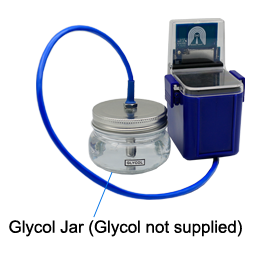
It is an industry standard best practice when monitoring the temperature inside medical refrigerators to place the sensor suspended in a jar of Glycol. This simulates the acual temperature of the pharmaceutical liquid and avoids false alarms caused by warm air entering the refrigerator, or fluctuations during the compressor cycles of the refrigerator.
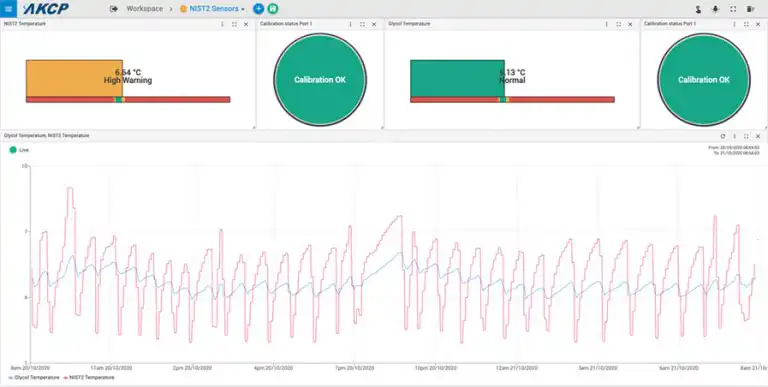
AKCP NIST2 and NIST3 wireless sensors are available with a Glycol Jar attachment for use in laboratories, medical refrigerators and the monitoring of vaccines. The graph below shows a comparison of a sensor exposed to the air temperatures inside the refrigerator (red) and the temperature of the sensor suspended in Glycol (blue). The dampending response is clearly seen, giving a more accurate measure of the temperature of the pharmaceuticals.