
Home » AKCP Blog » The Invisible Enemy: Why Air Quality Monitoring is Critical for Data Center Performance
The Invisible Enemy: Why Air Quality Monitoring is Critical for Data Center Performance
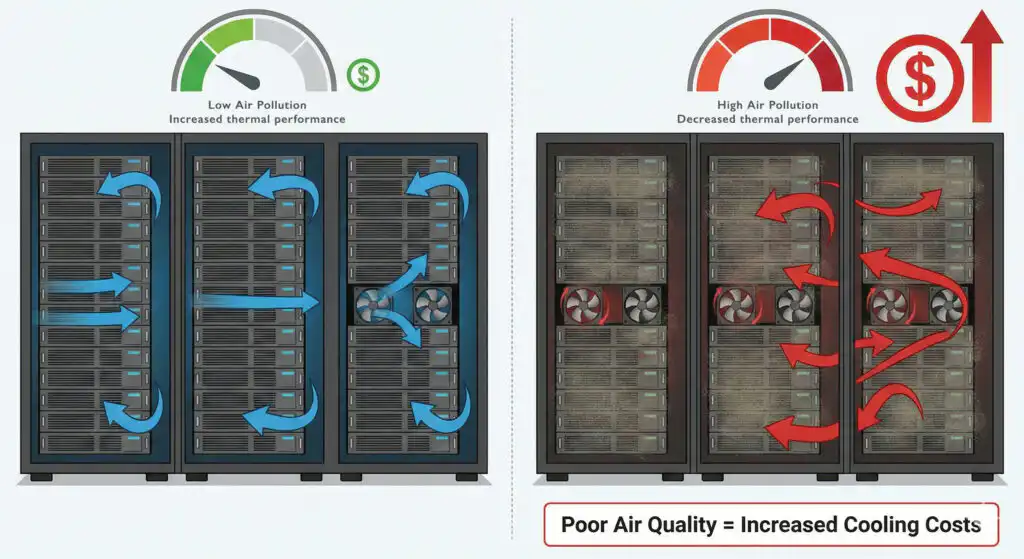
How often do you think about data center air quality? When we think of data center environmental monitoring, the “big two” immediately come to mind: temperature and humidity. These metrics are the industry standard for a reason; if a server room gets too hot, equipment fails. If it gets too humid, condensation forms. But there is a third, often invisible enemy that is silently eroding the efficiency, reliability, and lifespan of your critical infrastructure: Air Quality.
For many facility managers, air quality is an afterthought—something to worry about only during construction or in regions with heavy smog. However, the reality is that the microscopic environment inside your data center is just as critical as the thermal one. From dust and fibers to corrosive gases and volatile organic compounds (VOCs), airborne contaminants are a constant threat. They don’t just dirty your floor tiles; they attack your servers, choke your cooling systems, and drive up your energy bill.
In this post, we will explore the deep impact of poor air quality on data center operations, specifically focusing on the degradation of thermal efficiencies, the hidden costs of energy and downtime, and how advanced monitoring solutions from AKCP can provide the visibility you need to protect your assets.
The Particulate Problem: More Than Just Dust
Data centers are designed to be clean environments, but they are rarely hermetically sealed. Contaminants enter through ventilation systems, on the shoes and clothes of technicians, and through cracks in the building envelope. Once inside, these particles—often categorized by size as PM1.0, PM2.5, and PM10—begin to wreak havoc.
1. The Insulating Blanket and Airflow Obstruction
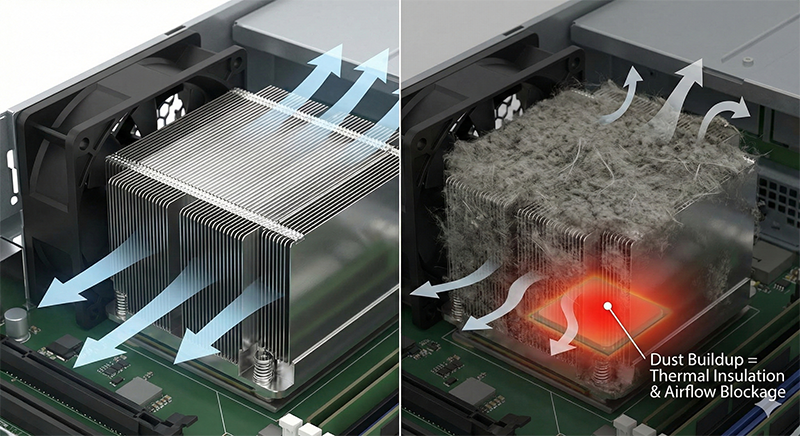
The most immediate physical effect of dust is its ability to act as a thermal insulator. Electronic components, particularly CPUs and GPUs, generate immense amounts of heat. This heat must be efficiently transferred to the heat sinks and then carried away by airflow.
When dust settles on a heat sink, it forms a “fuzzy” layer that drastically reduces the thermal conductivity between the metal fins and the passing air. This is not just a cosmetic issue; it is a physics problem. The dust layer traps heat close to the component, causing the internal temperature of the chip to rise even if the ambient room temperature is perfectly within ASHRAE guidelines.
Furthermore, dust doesn’t just settle on flat surfaces; it clogs the very pathways designed to keep servers cool. As particles accumulate on fan blades, intake vents, and internal grills, they reduce the effective cross-sectional area of these airways. The server fans must work significantly harder to pull the same amount of air through the chassis.
2. Corrosion and Electrical Shorts
Not all dust is created equal. In many urban or industrial areas, airborne particulate matter can be corrosive or conductive.
Conductive Dust: Metallic whiskers or carbon dust can bridge the tiny gaps between circuits on a motherboard, causing short circuits that can permanently destroy a server.
Corrosive Dust: When dust containing sulfur or nitrogen oxides combines with humidity, it can form acidic compounds that eat away at solder joints and copper traces. This “creep corrosion” is a silent killer, often causing intermittent failures that are impossible to diagnose until the hardware is physically inspected and found to be ruined.
The Thermal Efficiency Penalty: The Physics of Loss
To understand the true cost of dirty air, we have to look at thermal transfer efficiency. In a clean heat exchanger, the heat transfer coefficient is high, allowing for rapid dissipation of thermal energy. Research into data center cooling has shown that even a thin layer of dust can degrade the Nusselt number—a dimensionless ratio describing the efficiency of convective heat transfer—significantly.
In practical terms, a fouled heat sink might see a drop in heat transfer efficiency of 20% to 30%. This forces the entire cooling infrastructure to overcompensate. To maintain the same component temperature with a fouled heat sink, the temperature difference (ΔT) between the air and the component must increase, or the airflow must increase. Since you cannot easily make the chip hotter without risking failure, the system demands colder air or more of it. This breaks the delicate balance of data center cooling physics. You are no longer cooling the equipment; you are cooling the dust layer insulating the equipment.
Counting the Cost: Energy, Money, and Downtime
The degradation of air quality translates directly to the bottom line. These costs manifest in three primary ways:
1. The Energy Tax
Data centers are already massive energy consumers, with cooling often accounting for 30% to 50% of the total electricity usage. Poor air quality acts as a tax on every kilowatt of cooling power.
Fan Power: As mentioned, server fans consume non-trivial amounts of power (sometimes 10-15% of the server’s total load). When intake filters or internal components are clogged, fans may ramp up to 100% duty cycle, leading to a measurable spike in IT load.
Cooling Plant Efficiency: On a macro level, if dust clogs the evaporator coils of your CRAC/CRAH units, the heat exchange process becomes less efficient. The chillers must work harder to produce lower supply temperatures to compensate for the poor heat transfer at the rack level. This lowers your PUE (Power Usage Effectiveness) and inflates your monthly utility bill.
2. Equipment Lifespan and CapEx
Servers are expensive assets with a planned depreciation cycle of 3 to 5 years. Poor air quality accelerates this cycle. Fans that run at maximum speed wear out their bearings faster. Components subjected to higher running temperatures (due to dust insulation) suffer from electromigration, a physical breakdown of the material at the atomic level, leading to early failure. Replacing hardware prematurely due to preventable environmental damage is a massive capital expense (CapEx) leak.
3. The Cost of Downtime
The most frightening cost is an unplanned outage. Conductive dust causing a short circuit in a core router or a catastrophic thermal shutdown of a critical server bank can cost an organization thousands of dollars per minute. Beyond the direct financial loss, there is the reputational damage and the operational chaos of bringing systems back online. Air quality issues are rarely catastrophic immediately; they are insidious, causing “ghost” errors and intermittent crashes that baffle IT teams until the hardware eventually dies.
Mitigation Strategies: Defense in Depth
Protecting your data center from airborne contaminants requires a multi-layered approach involving filtration, pressure control, and strict operational protocols.
1. Filtration Standards
The first line of defense is your HVAC system. Modern data centers should employ high-efficiency filtration.
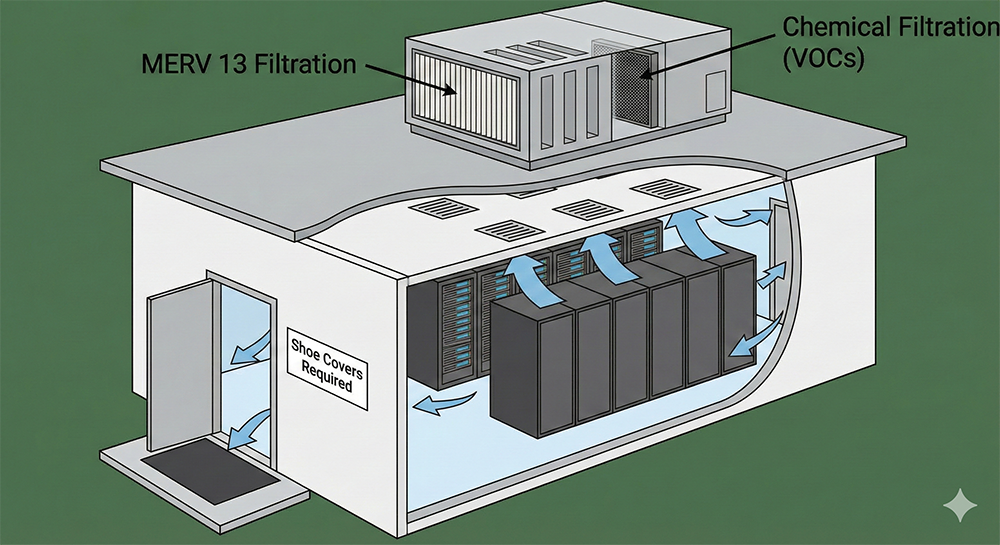
MERV Ratings: The Minimum Efficiency Reporting Value (MERV) rates how well a filter captures particles. While standard office buildings might use MERV 8, data centers should aim for MERV 13 or higher for intake air to capture fine particulate matter (PM2.5) and pollen.
Chemical Filtration: In areas with high levels of industrial pollution (SO2, NOx), gas-phase filtration using activated carbon or chemical scrubbers is essential to prevent corrosion.
2. Positive Pressurization
You should always maintain a positive pressure inside the white space relative to the outside world and adjacent office areas. This ensures that when a door is opened, clean air pushes out, preventing dirty, unconditioned air from sucking in.
3. Operational Hygiene
The “No Cardboard” Rule: Cardboard is a notorious source of particulate fibers. It should never be brought onto the server floor. Unpacking should happen in a staging area.
Sticky Mats: Placing tacky mats at every entrance traps dust from footwear before it enters the room.
Shoe Covers: Requiring booties for all personnel significantly reduces the dirt tracked in from the outdoors.
The Missing Link: Intelligent Monitoring with AKCP
You can install the best filters and write the strictest protocols, but without visibility, you are flying blind. How do you know if your filters are clogged? How do you know if a nearby construction site is sending a plume of dust into your intakes? How do you know if the humidity levels have combined with dust to create a corrosion risk?
This is where AKCP, the world’s oldest and largest manufacturer of networked wired and wireless sensor solutions, provides the critical missing link.
AKCP Air Quality Sensor (AQS)
The AKCP Air Quality Sensor is designed specifically to withstand the rigors of the data center environment while providing laboratory-grade accuracy. Unlike generic home air monitors, the AKCP AQS is an industrial tool built for critical infrastructure.
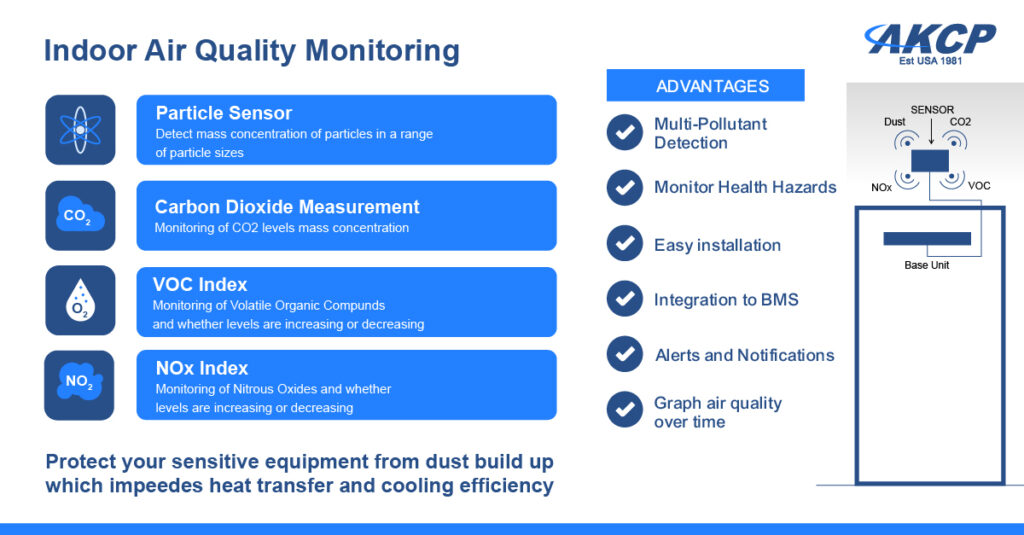
Particulate Matter Detection: The sensor detects PM1.0, PM2.5, PM4.0, and PM10 mass concentrations. This allows you to differentiate between fine combustion particles (like vehicle exhaust or smoke) and larger dust particles (like concrete dust or fibers), helping you identify the source of contamination.
Integrated Environmental Sensing: Air quality doesn’t exist in a vacuum. The AQS also measures Temperature and Humidity, allowing you to correlate pollution spikes with thermal events.
VOC and NOx Index: The sensor monitors Volatile Organic Compounds and Nitrogen Oxides. This is vital for detecting gaseous contaminants that standard dust filters miss—pollutants that cause the dreaded equipment corrosion.
Long-Life Design: AKCP utilizes a “Sheath Flow” technology that protects the internal sensor mechanism from dust accumulation, ensuring a lifespan of over 10 years. This is crucial for facility managers who want “install and forget” reliability.
The Power of Integration: AKCP sensorProbe+ and Quicklime
A sensor is only as good as the data it delivers. AKCP’s sensors connect seamlessly to the sensorProbe+ base units.
This ecosystem allows for actionable intelligence:
Automated Alerts: Set thresholds for particulate counts. If PM2.5 levels spike (indicating a filter breach or an open door), the system instantly sends email, SMS, or SNMP trap alerts to the operations team.
Filter Monitoring: By combining the AQS with AKCP’s Differential Air Pressure sensors, you can monitor the actual performance of your HVAC filters. Instead of changing filters on a generic 3-month schedule (which wastes money if they are clean, or risks equipment if they clog early), you can change them exactly when the pressure drop indicates they are full.
Visualization: All data can be visualized in Quicklime or your own BMS. You can graph air quality trends over time, spotting correlations between high traffic hours, outdoor weather conditions, and indoor pollution levels.
Preventing the “Perfect Storm”
Imagine a scenario where your humidity control drifts high, and simultaneously, a nearby diesel generator spike raises NOx levels in your intake air. Separately, these might be manageable. Together, they create a rapid corrosion environment. AKCP’s integrated monitoring would detect this “perfect storm” immediately, allowing you to seal intakes or activate scrubbers before your motherboards begin to corrode.
Conclusion
In the high-stakes world of data center management, ignoring air quality is a risk you cannot afford. The cost of a single outage or the premature replacement of a server rack far outweighs the investment in proper monitoring.
Polluted air is an energy thief and a hardware killer. It degrades thermal efficiency, forces cooling systems to work overtime, and silently eats away at the reliability of your infrastructure. By implementing robust mitigation strategies and deploying AKCP’s Air Quality Sensor monitoring solutions, you gain the visibility required to maintain a pristine, efficient, and reliable environment.
Don’t let the invisible enemy compromise your uptime. Clean air is not just about hygiene; it’s about performance.
- About the Author
- Latest Posts

For over two decades at AKCP, I have been focused on a single mission: bringing complete visibility, security, and efficiency to the world’s critical infrastructure.
I believe that in the modern data center, AI is only as good as the data it receives. My goal is to ensure facilities have the precise sensor facts needed to control AI opinions, ultimately reducing PUE, releasing stranded capacity, and ensuring maximum uptime.
- Monitoring Solutions for Edge UPS Problems in Modern Data Centers
- Data Center Power Monitoring When the Megawatts Move On-Site
- AKCP Launches IPSet Mobile App for Fast sensorProbe+ Network Configuration
- Battery Room Ventilation Requirements: The Two Compliance Paths and the Monitoring That Proves Both
- Environmental Monitoring Systems (EMS): The Complete Guide for Modern Infrastructure