Pharmaceutical and Laboratory
Monitor and protect vaccines
and temperature sensitive drugs
- Temperature and Humidity Sensors
- Wireless sensors for easy installation
- Differential Pressure for Sterile Areas
What goes wrong in your lab?
Pick a problem and watch it play out: the sensors catch it, your team gets the alert, the record or the camera shows what happened, and you know what to do. Compare the glycol-buffered probe with the air probe in the medical refrigerator.
Each one plays out in four steps: the sensors detect it, your team gets the alert, the camera or the record shows what happened, and what to do next. Tap any numbered point to see what it monitors.
{{sc.title}}
| Minute | {{mainLabel}} | {{refLabel}} |
|---|---|---|
| {{w.t}} | {{w.v}} | {{w.r}} |
Simulated readings with example limits, not data from a live installation. Time outside limits holds each sample until the next one, so it is an estimate.
A glycol-buffered probe adds thermal mass, smoothing short air fluctuations like a door opening. A sustained change still reaches the buffered reading. Probe placement and the stored material determine the appropriate monitoring setup.
This refrigerator example is not a recommendation to use the same buffer in a freezer or ultra-cold unit. Select a probe and installation rated for that application. The buffer does not measure every medicine's temperature or prove product viability.
Try Fridge door opened briefly above, then switch the alarm input on the refrigerator graph between the glycol-buffered probe and the air probe.
Regulatory requirements and good practice determine that monitoring of your drug storage environment is critical. Many vaccines and drugs require storage between 2°C and 8C (35.6°F to 46.4°F)
AKCP provides a solution for monitoring of temperature sensitive drugs and vaccines during transport and storage. 2x NIST traceable, calibrated temperature sensors are compared for accuracy once a second. Alerts are sent if the sensor is out of calibration.
NIST3 sensors feature 3x temperature sensors working with primary pair with calibration checks, providing failover should the pair be out of calibration.
Glycol Temperature Sensor for Medical Refrigerators

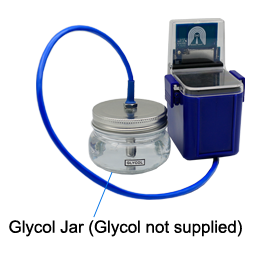
It is an industry standard best practice when monitoring the temperature inside medical refrigerators to place the sensor suspended in a jar of Glycol. This simulates the acual temperature of the pharmaceutical liquid and avoids false alarms caused by warm air entering the refrigerator, or fluctuations during the compressor cycles of the refrigerator.
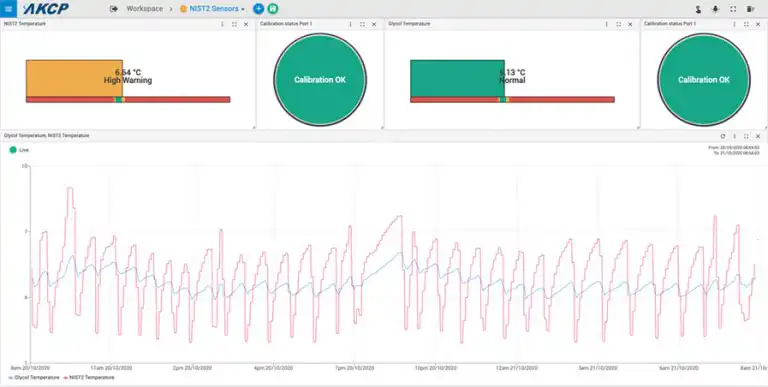
AKCP NIST2 and NIST3 wireless sensors are available with a Glycol Jar attachment for use in laboratories, medical refrigerators and the monitoring of vaccines. The graph below shows a comparison of a sensor exposed to the air temperatures inside the refrigerator (red) and the temperature of the sensor suspended in Glycol (blue). The dampending response is clearly seen, giving a more accurate measure of the temperature of the pharmaceuticals.