
Home » AKCP Blog » Beyond the Cold Aisle: Why Granular Thermal Mapping and AI-Driven CFD are Game-Changers for Data Center Cooling
Beyond the Cold Aisle: Why Granular Thermal Mapping and AI Driven sensorCFD are Game Changers for Data Center Cooling
AI Driven sensorCFD and Cabinet Thermal Map Sensors are an essential element of your data center airflow and energy management plan. If you are relying on a single temperature sensor in your cold aisle to dictate your data center cooling strategy, you might be flying blind. In our latest demonstration using Quicklime DCIM, we uncover the hidden dangers lurking in seemingly “perfect” cooling setups and explore how the combination of AKCP Cabinet Thermal Map Sensors, sensorCFD, and Local AI Analysis can revolutionize your facility’s efficiency.
Here is why granular rack-level monitoring is no longer just a luxury, but an absolute necessity.
The Illusion of “All Green” Alerts
Many data center operators assume that if the cold aisle is flooded with cold air, the servers are adequately cooled. However, air dynamics are rarely that simple.
In our video demonstration of a cold containment data center with raised floor cooling, we visualize a situation where a single temperature sensor in the cold aisle is insufficient. When analyzing the computational fluid dynamics (CFD), we observe cold air shooting up from the floor tiles at a high velocity. Because the air supply was over-pressurized but lacking in overall volume, the cold air shot straight to the ceiling, hit the top containment, and was entirely consumed by the top-of-rack servers.
The result? The servers in the middle of the rack were starved of cold air, leading to dangerous hotspots and recirculating warm air.
The crucial takeaway: If you placed a standard temperature sensor in the middle of that cold aisle, it would register cold air and trigger zero alerts. Everything would appear completely fine on your dashboard, even as the servers just inches away were baking.
The Solution: AKCP Cabinet Thermal Map Sensors
To catch these localized issues, you need to monitor at the granular level. This is where AKCP Cabinet Thermal Map Sensors come in.
Instead of treating a rack as a single entity, these sensors provide a complete thermal profile of the cabinet:
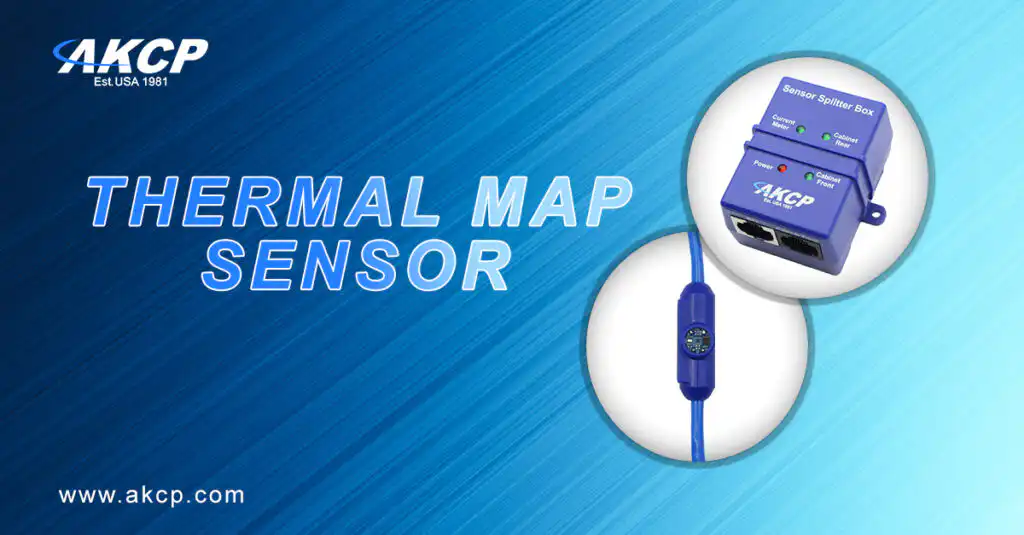
Strategic Placement: They utilize three temperature sensors at the front (top, middle, bottom) and three at the rear, along with humidity monitoring.
Delta T (∆T) Monitoring: By measuring the temperature differential between the front and the rear of the rack, the sensors can immediately identify if a specific section of a cabinet is suffering from poor airflow or exhaust recirculation.
Thermal map sensors expose the problems occurring within the rack, rather than giving you an unhelpful average of the aisle.
Visualizing the Invisible with AI Driven sensorCFD
To truly understand how air is moving around your facility, you need more than just raw numbers. sensorCFD, built into Quicklime, takes real-world data from your AKCP thermal maps and uses it as the foundational input to calculate highly accurate airflow models.
Unlike traditional CFD models that rely on theoretical design data, AI Driven sensorCFD shows you what is happening in almost real-time. The visual slice differentiates between:
Air Speed: Arrow colors indicate air velocity (meters/second), helping you spot high-pressure bypass air.
Temperature: Solid background colors instantly highlight cold zones and alarming hotspots.
The Ultimate Analyst: Quicklime’s Local AI Engine
Identifying a hotspot is only half the battle; knowing exactly how to fix it is the ultimate goal.
Recently, we’ve implemented an advanced AI Large Language Model (LLM) directly into the Quicklime DCIM. Because this AI engine is locally hosted, your data center’s infrastructure data remains completely secure.
Instead of forcing you to manually interpret complex CFD slices, the AI analyzes the sensorCFD output. It doesn’t just tell you where the problem is. Instead it generates a comprehensive report with actionable, recommended steps to remedy the situation. Whether you need to balance floor tiles, adjust fan speeds, or fix containment leaks, the AI acts as an expert consultant available 24/7.
Pushing the Limits of Efficiency
Modern data centers demand peak efficiency, maximum uptime, and optimized energy usage. You can no longer afford to over-cool an entire room just to compensate for a few hidden hotspots.
By upgrading to AKCP’s granular thermal mapping and leveraging the AI-driven insights of sensorCFD within Quicklime DCIM, you can eliminate guesswork, prevent hardware failure, and confidently push your facility’s efficiency to the absolute limit.
Want to learn more about implementing these tools in your facility? Reach out to AKCP today!
- About the Author
- Latest Posts

For over two decades at AKCP, I have been focused on a single mission: bringing complete visibility, security, and efficiency to the world’s critical infrastructure.
I believe that in the modern data center, AI is only as good as the data it receives. My goal is to ensure facilities have the precise sensor facts needed to control AI opinions, ultimately reducing PUE, releasing stranded capacity, and ensuring maximum uptime.
- Data Center Power Monitoring When the Megawatts Move On-Site
- AKCP Launches IPSet Mobile App for Fast sensorProbe+ Network Configuration
- Battery Room Ventilation Requirements: The Two Compliance Paths and the Monitoring That Proves Both
- Environmental Monitoring Systems (EMS): The Complete Guide for Modern Infrastructure
- The Data Center Water Footprint: 2026 AI Impact & Statistics