
Home » AKCP Blog » The Data Center Water Footprint: 2026 AI Impact & Statistics
The Thirsty Servers: The True Water Footprint of Data Centers in the AI Era
The Scale of the Thirst: AI’s Hidden Cost
- AI Text Queries: Generating a single response from a Large Language Model (LLM) consumes between 10 to 50 milliliters of water.
- AI Image Generation: Creating a single AI image uses roughly 23 milliliters of water.
- The Global Impact: As AI expands, tech giants are seeing massive spikes in consumption. Google’s global data center water use reportedly hit 8.1 billion gallons recently.
The Two-Front Problem: Scope 1 vs. Scope 2 Water
- Scope 1 (Direct Water): Water consumed on-site. It is the freshwater pumped directly into the facility’s evaporative cooling towers to keep the hardware from overheating.
- Scope 2 (Indirect Water): This is the hidden footprint. Data centers require massive amounts of electricity. Scope 2 measures the water evaporated off-site at the power plants (like thermoelectric, coal, or nuclear plants) generating that electricity.
The Green Infrastructure Catch-22 (PUE vs. WUE)
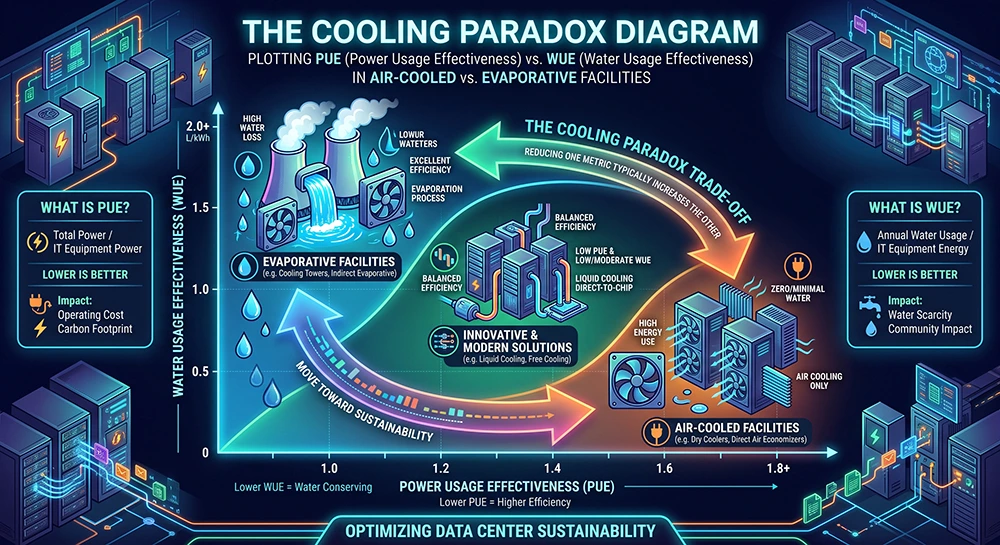
- Evaporative cooling is highly energy-efficient, lowering a facility’s Power Usage Effectiveness (PUE). However, it guzzles millions of gallons of water, ruining the facility’s WUE.
- Air-cooled systems (like large HVAC chillers) use almost zero water, resulting in a perfect WUE. However, they require massive amounts of electricity to run the compressor fans, driving up the PUE and increasing the Scope 2 carbon and water footprint at the power plant level.
Community Pushback and the Regulatory Future
- In Ireland, data centers recently consumed over 20% of the country’s metered electricity, prompting the national grid to effectively pause new data center approvals around Dublin to protect local infrastructure.
- In the United States, states like Virginia and Minnesota have begun scrutinizing data center developments, drafting legislation that requires strict reporting on water usage and pushing for sustainable conservation measures.
The rapid expansion of data centers hasn’t gone unnoticed, sparking widespread backlash from environmentalists, farmers, and local residents. In water-stressed regions, these facilities are accused of draining precious resources, leading to dried-up wells, soaring municipal water costs, and disrupted ecosystems.
In rural Georgia, for instance, communities near Meta’s data centers report contaminated or depleted water supplies, with one resident lamenting, “I can’t drink the water.” Similar stories emerge from Arizona, where data centers compete with agriculture for limited water, potentially reducing crop yields and inflating prices for farmers. In South Carolina, conservation groups criticized Google’s permit to draw 1.5 million gallons daily, arguing it prioritizes tech over local needs.
Environmentally, the impacts are profound. Data centers worsen drought conditions in already vulnerable areas, contributing to habitat loss and biodiversity decline. In the American West, where water scarcity affects millions, the cooling demands of these centers threaten rivers and aquifers, prompting calls for moratoriums on new builds. Critics argue that while tech companies tout sustainability, their opaque water usage data hides the true cost to communities and the planet.
This tension has led to project delays and blocks worth $64 billion, as locals push back against noise, energy strain, and water hogging in the name of “anti-tech” sentiment.
Putting It in Perspective: How Data Centers Stack Up Against Other Industries
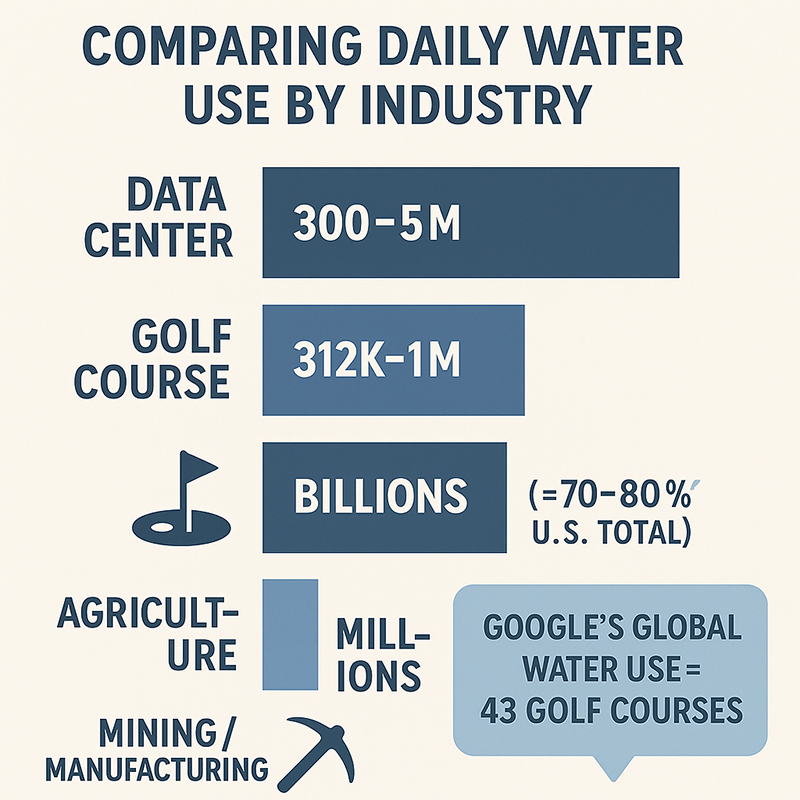
While data centers’ water use is significant, it’s worth comparing them to other sectors to avoid undue vilification. Agriculture, for example, dominates water consumption in many areas, accounting for 86% of total usage in states like Arizona, dwarfing the industrial share that includes data centers at around 8%.
Take golf courses, often cited as a benchmark for inefficiency. A typical 18-hole golf course in the U.S. uses about 312,000 gallons of water per day for irrigation, particularly in arid areas like Palm Springs. In hotter climates, this can climb to 1 million gallons per night or up to 2.08 billion gallons annually for an 18-hole facility. Nationally, golf courses collectively use around 2 billion gallons daily, representing 0.5% of U.S. water withdrawals.
How do data centers compare? A single Google data center in Virginia consumed 173.2 million gallons in a year. This equivalent to about 1.2 golf courses. But it is serving millions of people worldwide, so on a per person basis, its water use is much lower than a golf course that caters to a few hundred members. Google’s global footprint equals roughly 43 golf courses. However, data centers often recycle water or use non-potable sources, whereas golf courses typically draw from freshwater for turf maintenance. Mining and manufacturing also rival or exceed data centers in water intensity, but agriculture remains the heavyweight.
| Industry/Sector | Average Daily Water Use (Gallons) | Key Impacts |
|---|---|---|
| Medium Data Center | 300,000 (Mid) – 5,000,000 (Hyperscaler) | Strains local supplies in drought areas; indirect energy water use |
| Typical Golf Course | 312,000 – 1,000,000 (In arid regions) | Irrigation in arid regions; chemical runoff affects ecosystems |
| Agriculture (U.S. Overall) | Billions (~47% of total U.S. freshwater withdrawals) | Crop irrigation; major cause of aquifer depletion |
| Mining (Per Operation) | Varies, often millions (e.g., 2M-8M gallons per ton of ore) | Contamination and habitat disruption |
Tackling the Issue: Innovations and Efficiency in the Data Center Industry
The good news? The data center industry isn’t ignoring the problem. Companies are investing in technologies and metrics to curb water use, aiming for “water-positive” operations where they replenish more than they consume.
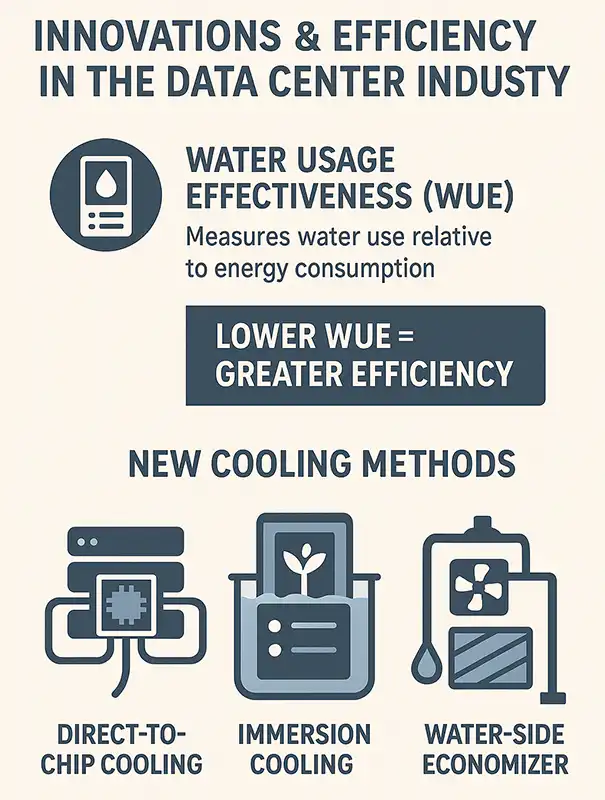
A key metric is Water Usage Effectiveness (WUE), which measures efficiency by dividing total onsite water consumption (in liters) by the energy used for IT equipment (in kilowatt-hours). Lower WUE scores indicate better performance; for example, Microsoft tracks WUE to optimize humidification and cooling, targeting reductions through real-time adjustments. Best practices include collecting usage data, reusing wastewater, and shifting to air-based or hybrid cooling systems.
To reduce consumption, operators are adopting advanced cooling methods. Direct-to-chip cooling circulates liquid directly over processors, slashing water needs by up to 95% in some cases. Immersion cooling submerges servers in non-conductive fluids, eliminating evaporative water use entirely. Water-side economizers leverage cooler outdoor air to minimize evaporation.
Looking ahead, future technologies promise even greater strides. Circular water systems treat and recycle onsite water, potentially achieving zero net consumption. Water-free data centers, using advanced air cooling or geothermal methods, are on the horizon, though challenges like salt corrosion in seawater alternatives persist. Microsoft, for one, pledges a 95% reduction in evaporative water use by 2024, while others explore AI-optimized systems for predictive efficiency.
Quenching the Thirst: How the Industry is Adapting
Data centers are not ignoring the problem. The industry is actively shifting toward solutions that balance both power and water efficiency—and the key to achieving this balance lies in precise environmental control.
Raising Operating Temperatures: Historically, data centers were kept aggressively cold (in the low 60s °F). Today, ASHRAE guidelines allow servers to run much warmer, significantly reducing the need for continuous evaporative cooling. However, running a warmer data center leaves less margin for error, making real-time temperature tracking critical.
Embracing Liquid Cooling: Direct-to-chip and immersion cooling systems remove heat far more efficiently than air, drastically reducing a facility’s reliance on massive evaporative cooling towers. But bringing water and dielectric fluids closer to the server racks introduces new risks, making automated leak detection a mandatory safety measure.
Precision Environmental Monitoring: You cannot optimize what you do not measure. To safely balance the PUE vs. WUE catch-22, modern facilities rely on granular data. By deploying an AKCP sensorProbe+ system equipped with Thermal Map and Cabinet Analysis Sensors, facility managers can monitor the exact temperature differentials (ΔT) at the front and rear of individual racks. Instead of blasting an entire aisle with water-intensive cooling, managers can map thermal hotspots in real-time and dynamically adjust cooling only where it is strictly necessary.
Safeguarding the Infrastructure: As facilities push for higher water efficiency or transition to liquid cooling loops, they must also protect against catastrophic leaks. Integrating AKCP Rope Water Sensors beneath raised floors or along cooling pipe runs ensures that your water conservation efforts do not result in undetected hardware damage.
The Takeaway: The days of blindly pumping millions of gallons of water through a data center are over. In 2026, sustainable data center management requires visualizing your exact environmental footprint. Tools like AKCP’s Quicklime software and environmental sensors bridge the gap between keeping your servers online and keeping your water footprint in check.
Frequently Asked Questions (FAQ)
Q: Why do data centers consume so much water?
Data centers generate massive amounts of heat from thousands of high-density servers running 24/7. To prevent hardware failure, most facilities rely on evaporative cooling systems and cooling towers. These systems use large volumes of water to absorb and dissipate heat into the atmosphere, which is highly effective but consumes millions of gallons of freshwater.
Q: How much water does a typical data center use?
A medium-sized data center consumes around 110 million gallons of water annually, which averages out to roughly 300,000 gallons per day. However, large hyperscale data centers operating in hot climates can consume anywhere from 1 million to 5 million gallons of water every single day.
Q: How does Artificial Intelligence impact data center water usage?
AI requires significantly more computing power than standard web browsing or cloud storage, leading to hotter servers and higher cooling demands. For context, a standard web search uses roughly 0.6 drops of water, while generating a single AI text response can consume between 10 to 50 milliliters of water.
Q: What is Water Usage Effectiveness (WUE)?
Water Usage Effectiveness (WUE) is a standard metric used to measure data center sustainability. It is calculated by dividing the facility’s annual water usage (in liters) by the energy consumed by the IT equipment (in kilowatt-hours). A lower WUE score indicates a more water-efficient facility.
Q: What is the difference between Scope 1 and Scope 2 water footprints?
Scope 1 refers to the direct water consumed on-site by the data center, primarily through its evaporative cooling towers. Scope 2 refers to the indirect water footprint, which is the water evaporated off-site at the power plants generating the massive amounts of electricity the data center requires to run.
Q: Can data centers be cooled without water?
Yes, data centers can use alternative methods like air-cooled chillers, direct-to-chip liquid cooling, or dielectric fluid immersion cooling, which use little to no continuous water. However, there is a trade-off: traditional air-cooled systems typically require much more electricity than water-cooled systems, forcing engineers to balance water conservation with energy efficiency.
- About the Author
- Latest Posts

For over two decades at AKCP, I have been focused on a single mission: bringing complete visibility, security, and efficiency to the world’s critical infrastructure.
I believe that in the modern data center, AI is only as good as the data it receives. My goal is to ensure facilities have the precise sensor facts needed to control AI opinions, ultimately reducing PUE, releasing stranded capacity, and ensuring maximum uptime.
- Monitoring Solutions for Edge UPS Problems in Modern Data Centers
- Data Center Power Monitoring When the Megawatts Move On-Site
- AKCP Launches IPSet Mobile App for Fast sensorProbe+ Network Configuration
- Battery Room Ventilation Requirements: The Two Compliance Paths and the Monitoring That Proves Both
- Environmental Monitoring Systems (EMS): The Complete Guide for Modern Infrastructure