
Home » AKCP Blog » Environmental Monitoring Systems (EMS): The Complete Guide for Modern Infrastructure
Environmental Monitoring Systems (EMS): The Complete Guide for Modern Infrastructure
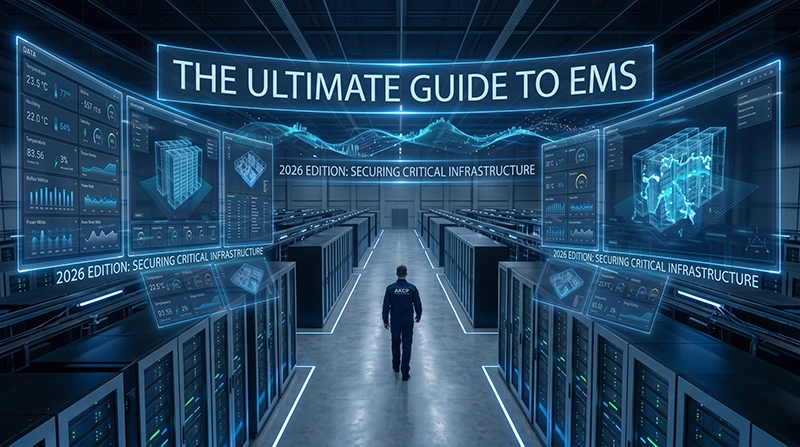
Why Environmental Monitoring is Critical Today
- Irreversible hardware damage: Heat can kill sensitive electrical components in minutes.
- Compliance failures: Strict regulations (like GMP in pharmaceuticals) mandate continuous, logged environmental data.
- Energy waste: Overcooling to compensate for “hot spots” drives up power bills and worsens data center PUE (Power Usage Effectiveness).
Key Applications of Environmental Monitoring Systems
1. Data Center Environmental Monitoring
- Thermal Mapping: Using temperature sensors at the top, middle, and bottom of racks to detect differential pressure and heat clustering.
- Water Leak Detection: Rope sensors deployed under raised access flooring to catch plumbing or AC condensate leaks instantly.
- Automated Remediation: Sensor-controlled relays can automatically switch on additional cooling fans or alert AI engines to adjust HVAC output, significantly lowering PUE and releasing stranded capacity.
2. Remote Telecom & BTS (Base Transceiver Station) Monitoring
- HVAC unit failures in extreme summer heat.
- Intrusion and physical security breaches.
- Battery health and generator fuel levels.
3. Pharmaceutical, Laboratory, and Cold Chain
Essential Sensors in a Modern EMS Setup
| Sensor Type | Primary Function | Ideal Deployment |
Temperature & Humidity | Detects heat spikes and moisture levels that cause static or condensation. | Server racks, cleanrooms, cold storage. |
Water Leak (Rope/Spot) | Identifies conductive liquids before they reach electrical equipment. | Under raised floors, near CRAC units. |
Airflow & Air Quality | Measures the presence of cooling wind and detects particulates (PM2.5) or VOCs. | HVAC ducts, containment aisles, labs. |
Power Monitoring | Tracks voltage drops, battery health, and current usage. | PDUs, UPS systems, telecom batteries. |
Security & Access | Logs who opened a cabinet and detects motion or vibration. | IT cabinets, remote cell towers. |
Industry-Leading Solutions from AKCP
- sensorProbe+: Intelligent, highly customizable hubs that aggregate data from wired and wireless sensors.
- Wireless Tunnel™ Technology: Long-range, low-power wireless sensors perfect for expansive warehouses or hard-to-reach telecom sites.
- Quicklime Server (Central Management): A world-class software platform that aggregates sensor data, generates custom thermal visualizations, calculates real-time PUE, and integrates deeply with AI algorithms to optimize your facility’s footprint.
What is the difference between an Environmental Monitoring System (EMS) and a Building Management System (BMS)?
A Building Management System (BMS) controls macro-level facility operations like primary HVAC, lighting, and fire systems across an entire structure. An Environmental Monitoring System (EMS) provides micro-level, granular visibility—specifically tracking conditions like rack inlet temperatures, localized water leaks, differential pressure, and micro-climates directly around critical hardware. EMS can operate independently or integrate into a BMS via protocols like Modbus or SNMP.
How do wireless sensors compare to wired sensors in an EMS deployment?
Wired sensors offer maximum reliability, zero battery maintenance, and immediate response times, making them ideal for high-density server racks and critical control panels. Wireless IoT sensors (such as Wireless Tunnel™ technology) eliminate expensive cabling runs and enable rapid deployment across vast warehouses, sprawling telecom networks, or hard-to-reach locations where running wire is impractical.
How does an EMS help reduce Data Center PUE (Power Usage Effectiveness)?
An EMS uses precise thermal mapping sensors at the bottom, middle, and top of server racks to identify hot spots and cold air bypasses. By providing real-time data on exact cooling needs, operators can safely raise ambient setpoints and reduce CRAC fan speeds without risking hardware failure, significantly trimming cooling energy costs and improving PUE.
Can an EMS alert operators before a failure actually happens?
Yes. Modern EMS platforms go beyond static threshold alarms. By utilizing continuous trend logging, AI analytics, and predictive alerting, the system detects micro-trends—such as gradual temperature rises, abnormal humidity shifts, or battery voltage drops—giving facility managers time to resolve issues before equipment overheats or shuts down.
What protocols do AKCP Environmental Monitoring Systems support?
AKCP base units support standard industry protocols for seamless integration into existing IT and facility software. Supported protocols include SNMP (v1, v2c, v3), MQTT for cloud/IoT applications, Modbus RTU/TCP, HTTPS, and REST APIs, alongside built-in alert mechanisms like email, SMS, and SNMP traps.
- About the Author
- Latest Posts

For over two decades at AKCP, I have been focused on a single mission: bringing complete visibility, security, and efficiency to the world’s critical infrastructure.
I believe that in the modern data center, AI is only as good as the data it receives. My goal is to ensure facilities have the precise sensor facts needed to control AI opinions, ultimately reducing PUE, releasing stranded capacity, and ensuring maximum uptime.
- Monitoring Solutions for Edge UPS Problems in Modern Data Centers
- Data Center Power Monitoring When the Megawatts Move On-Site
- AKCP Launches IPSet Mobile App for Fast sensorProbe+ Network Configuration
- Battery Room Ventilation Requirements: The Two Compliance Paths and the Monitoring That Proves Both
- Environmental Monitoring Systems (EMS): The Complete Guide for Modern Infrastructure