Data centers concentrate critical computing, electrical and cooling infrastructure into spaces where a security incident or developing equipment fault can have expensive consequences. According to Uptime Intelligence’s 2026 outage analysis, 57% of respondents said their most recent major outage cost more than US$100,000, while one in five reported a cost above US$1 million. At the same time, the International Energy Agency expects global data center electricity use to rise from approximately 485 TWh in 2025 to around 950 TWh by 2030, driven in large part by AI workloads.
Higher power density does not automatically cause failures, but it makes visibility across the power, cooling and security systems increasingly important. Thermal imaging
cameras add visibility by detecting infrared energy emitted by people, vehicles and equipment. Correctly specified and integrated, they can support three valuable data center functions:
- perimeter intrusion detection in darkness and difficult lighting;
- early identification of abnormal heat in electrical and mechanical equipment; and
- condition-based and predictive maintenance.
Thermal imaging is not a replacement for CCTV, fire detection or calibrated environmental sensors. Its greatest value comes from combining thermal information with these elements to create a layered monitoring system.
Thermal imaging, IR night vision and thermal mapping are not the same
The term “infrared camera” is often used for different technologies. Understanding the distinction prevents incorrect specifications and unrealistic expectations.
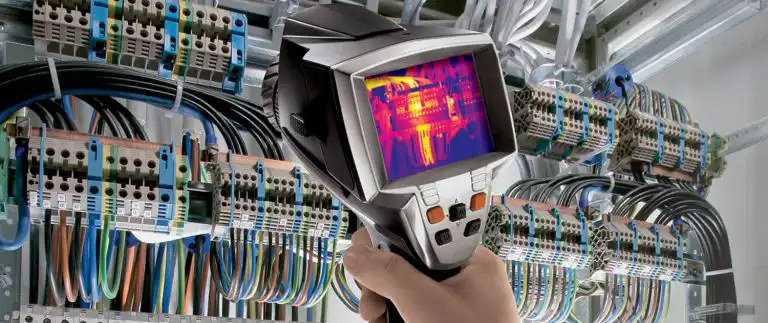
Thermal imaging cameras detect infrared radiation emitted by surfaces and convert small temperature differences into an image. They do not require visible light or an IR illuminator. A person, vehicle, cable termination or electrical component can therefore stand out because of its thermal contrast with the surrounding scene.
Radiometric thermal cameras go further by assigning a temperature value to pixels or defined measurement areas. This makes them suitable for equipment condition monitoring, temperature alarms and trend analysis. A non-radiometric thermal security camera may be excellent at detecting a person but unable to provide reliable equipment temperature measurements.
IR night-vision cameras are conventional visible-light cameras with near-infrared illumination. Their LEDs illuminate the scene, and the camera records reflected IR light, usually as a monochrome image. They are useful for recognizing a face, badge, cabinet, or action in darkness, but they do not produce a temperature map.
Rack thermal map sensors are arrays of contact or air-temperature sensors positioned at the front and rear of a cabinet. They measure rack inlet and exhaust air temperatures and calculate Delta T. Unlike a thermal camera, they provide continuous, calibrated air-temperature data at the locations that matter to IT equipment.
In a strong data center design, these technologies complement one another: thermal cameras detect a heat signature or anomaly, visible-light cameras provide identification and forensic detail, and environmental sensors verify the condition with calibrated measurements.
How thermal cameras improve data center physical security
Perimeter intrusion detection in darkness
Thermal cameras detect the contrast between a target and its background so they can identify people or vehicles in complete darkness, strong backlighting, and many visually confusing scenes.
This makes thermal cameras useful along fence lines, service roads, loading areas, rooftops, utility yards and other external approaches to a data center. AI video analytics can classify people and vehicles, apply virtual tripwires or exclusion zones, and direct a visible-light pan-tilt-zoom camera toward a detected target for verification.
Early detection of electrical and mechanical problems
Many electrical defects produce abnormal heat before they lead to a trip, outage or fire. Loose or high-resistance connections, overloaded conductors, phase imbalance, deteriorating contacts and failing components can create a thermal pattern that is invisible to the eye.
Infrared thermography can be used to inspect or continuously monitor critical infrastructure such as:
- utility feeds, transformers and switchgear;
- busways, automatic transfer switches and generator connections;
- UPS systems, battery strings and battery terminals;
- power distribution units, remote power panels and circuit breakers;
- cable joints, lugs and terminations;
- cooling pumps, motors, bearings, compressors and air-handling equipment; and
- server power supplies, rack PDUs and other accessible surfaces.
Apparent temperature can be affected by equipment load, emissivity, viewing angle, reflected temperature, distance, and the camera’s calibration. Shiny metal has low emissivity and may reflect another heat source, producing a misleading result.
Thermal cameras also cannot see through walls, closed metal panels, or ordinary glass. A camera pointed at a closed cabinet measures the cabinet’s visible surface, not the energized components behind it. Where justified by the risk assessment, purpose-designed infrared inspection windows can provide a view of internal equipment without routinely opening the enclosure. Electrical inspections must still follow the facility’s electrical safety program and be performed by qualified personnel.
Thermal imaging for early fire warning
A radiometric camera can alarm when a defined region exceeds an absolute temperature, develops an abnormal temperature difference or rises faster than an established rate. Fixed cameras are especially useful where critical assets operate continuously and a periodic handheld inspection could miss a fast-developing fault.
Potential applications include UPS and battery rooms, electrical rooms, generator areas, cable spaces and high-risk mechanical equipment. A thermal alarm may identify a hot surface before enough smoke is produced to activate conventional detection, giving operators more time to investigate and isolate the problem.
Thermal imaging should supplement, not replace, smoke detection, aspirating smoke detection, fire alarm and suppression systems. It measures surface radiation rather than combustion products, and not every fire begins with a visible surface-temperature anomaly.
Thermal imaging and data center cooling
Thermal images reveal surface-temperature patterns associated with failed fans, obstructed airflow, hot-air recirculation, missing blanking panels, leaking containment or uneven cooling. They are valuable during commissioning, troubleshooting, as well as before-and-after verification of airflow changes.
However, a thermal camera measures surfaces, not the air entering the server. For continuous thermal compliance and capacity management, use rack inlet and exhaust temperature sensors at defined heights.
ASHRAE’s 2021 Thermal Guidelines for Data Processing Environments recommends an 18–27°C inlet range for Classes A1 to A4, while the high-density H1 class has a narrower recommended range of 18–22°C. The allowable range depends on the equipment class and should not be confused with the recommended operating envelope.
AKCP’s
Cabinet Thermal Map Sensor measures temperature at the top, middle and bottom of the rack front and rear, together with humidity and rack Delta T. The
Cabinet Analysis Sensor adds differential pressure for analyzing airflow through the cabinet. These measurements provide a more suitable continuous input for rack thermal management and sensor-backed CFD than a camera image alone.
Handheld surveys or fixed thermal monitoring?
Both approaches have a place in a data center maintenance strategy.
Handheld thermal surveys are flexible and cost-effective for periodic inspection. A trained thermographer can change viewing positions, account for reflections, examine several assets, and correlate the image with electrical load. Surveys should use a repeatable route, consistent asset identification and comparable operating conditions.
Fixed radiometric cameras provide continuous observation of selected high-risk assets. They can monitor multiple regions of interest, alarm on absolute temperature or Delta T, and pass events to a building management system, DCIM platform, video management system or network management system. Their value is highest where the asset is critical, the failure can develop quickly or access for manual inspection is limited.
How to select a thermal camera for a data center
| | | |
| Thermal measurement | Usually optional | Radiometric measurement required |
| Resolution and lens | Sized for target detection, recognition and scene coverage | Sized so the smallest component or connection has enough measurement pixels |
| Thermal sensitivity | Lower NETD improves contrast and analytics stability | Lower NETD helps reveal small temperature differences |
| Analytics | Person/vehicle classification, tripwire, loitering and tamper alarms | Regions of interest, absolute temperature, Delta T and rate-of-rise alarms |
| Visual verification | Dual-sensor camera or paired visible-light PTZ preferred | Paired visible image helps identify the exact component |
| Integration | VMS, access control, ONVIF events and alarm I/O | BMS/DCIM/NMS through supported protocols, alarm I/O or API |
| Environmental protection | Suitable IP/IK rating, operating range and weather performance | Correct operating range, mounting, focus and calibration for the room |
| Cybersecurity | Unique credentials, HTTPS, least privilege, signed updates, logs and network segmentation | The same controls, plus restricted access to alarm and measurement configuration |
“Higher resolution is always better” is too simplistic. Resolution, lens focal length, field of view and distance must work together so that the target occupies enough pixels.
Thermal sensitivity is expressed as Noise Equivalent Temperature Difference, or NETD. A lower value indicates that the camera can distinguish smaller temperature differences. When comparing cameras with similar resolution, a model below 30 mK may preserve more image detail and analytics stability than a 50 mK model in low-contrast or adverse conditions. NETD does not replace measurement accuracy, lens or calibration requirements.
For interoperability, ONVIF Profile T supports modern IP-video streaming and alarm events, while Profile M standardizes metadata and events used by analytics applications. Confirm conformance for the exact camera and client products; a general claim of “ONVIF compatible” is less useful than matching supported profiles and functions.
Cybersecurity requirements for network thermal cameras
Every network camera is also an endpoint on the data center network. A poorly managed camera can create a cyber risk even when it improves physical security. Procurement and deployment should include:
- unique device identities and non-default credentials;
- HTTPS and encrypted management connections;
- role-based access with least privilege;
- network segmentation from production IT workloads;
- signed firmware and a documented security-update process;
- centralized time synchronization, logging and alert forwarding;
- disabled unused services and interfaces; and
- lifecycle planning for vulnerability disclosure and end-of-support.
These controls align with the device identification, configuration, data protection, interface access, software update and cybersecurity-state capabilities described in the
NISTIR 8259 series for securable IoT devices.
Relevant data center and thermography standards
Thermal imaging does not make a facility compliant by itself, but it can support a standards-based security and maintenance program:
- ISO/IEC 22237-6:2024 specifies requirements and recommendations for physical security systems in data center facilities and infrastructure.
- ANSI/TIA-942-C covers data center architecture, power, cooling, telecommunications, fire protection, physical security, safety, monitoring and surveillance.
- NIST SP 800-53 Rev. 5, PE-6 addresses monitoring physical access to facilities containing information-system components.
- ISO 18434-1:2008 provides general procedures for infrared thermography in machine condition monitoring, including emissivity, reflected temperature, severity criteria and reporting.
- ISO 18434-2:2019 provides guidance for thermogram interpretation and diagnostics.
- NFPA 70B (2026) establishes requirements for electrical equipment maintenance and includes infrared thermography as a predictive-maintenance technique. Apply it together with relevant electrical-safety requirements and local regulations.
- ASHRAE Thermal Guidelines, Fifth Edition (2021) provides recommended and allowable environmental envelopes for air- and liquid-cooled IT equipment, along with guidance on facility temperature and humidity measurement.
Applicable standards and legal requirements vary by location, facility type, and customer obligation. Qualified security, fire protection, electrical, and data center professionals should review the final design.
Integrating thermal imaging with AKCP monitoring
The most useful alarm is one that gives an operator enough context to act. AKCP monitoring can correlate video, access and environmental events so a response team sees what happened, where it happened and what other conditions changed at the same time. With
Quicklime DCIM security, sensor and video events are combined. IP based video streams with AI video analytics correlate sensor data to events to generate alerts.
For equipment cooling,
AKCP rack thermal map sensors provide the continuous, calibrated measurements needed to verify the condition that a thermal image suggests. This is the practical distinction between seeing an unusual heat pattern and confirming that rack inlet temperature,
Delta T, airflow, or power has moved outside its normal operating range.