Home » AKCP Blog » Differences Between Hyperscale and Colocation Data Centers
Differences Between Hyperscale and Colocation Data Centers
Hyperscale data centers are on the rise: there were about 500 of these large-scale facilities in 2019, up 30% from 2017. Many clients are re-evaluating their data center spaces.
To help with these considerations, we’ll review what a hyperscale data center is. And how it differs from a colocation data center, the use cases these services support, and how they can work together to power a digital infrastructure. We’ll also look at the future of the data center and the role virtualization will play. Retail vs. Wholesale Colocation
Many firms prefer to deploy infrastructure into one or more colocation facilities. Then it will interconnect with other enterprises and service providers that are housed in the same facilities. Retail and wholesale are the two most common routes to colocation. The best colocation arrangement is determined by the needs of the firm. In general, retail offers more flexibility, but wholesale offers more control. Retail Colocation
Companies rent rack, cage, or cabinet space for implementing their own IT equipment in retail colocation. Companies have little control over the space in this model. However, they have quick access to cabling, racks, power, cooling, fire suppression systems, physical security, and other amenities. Consider it like booking a hotel stay. There are only a few accommodation types available. And yet, all amenities are available to use. If you’re on a digital transformation journey and need the largest flexibility for changing IT requirements, retail colocation makes sense. Wholesale Colocation
A company’s needs may be more stable in some situations especially if it wants to store huge amounts of data and run critical business applications in the same location for the next ten years. In this case, a wholesale colocation method would be preferable because it allows more control at a lower cost. A wholesale model allows corporations to design and build their own space. It also necessitates a commitment to lease larger amounts of space and power. This is often based on one or more discrete power distribution units (PDU), such as a 2 MW generator. They usually need to bring all their own resources to design and build the space like racks, cabinets, power, and so on. This is more like leasing property to develop your own hotel than reserving a hotel room. The more control and time you have, the higher the price. Larger corporations, large content and media providers, large cloud service providers, as well as hosting, IT managed services, and telecommunications companies, are all common wholesale colocation customers.
Many companies also combine these approaches. Leasing wholesale data center space in locations around the world. Depends on where their business growth warrants, while using retail colocation in areas with limited growth or evolving needs. Retail Vs. HyperScale Data Centers
With the distinction between retail and wholesale colocation clear, we can now discuss the differences between retail and hyperscale data centers.
Retail Data Centers
Retail data centers house thousands of client companies that can get colocation space using either model. Retail colocation space, including power and cooling, is offered as a monthly service contract like the way managed services and cloud services are offered. These contracts are measured in 12, 24, or 36-month increments. Wholesale colocation space always requires a lease, generally 5 to 20-year contracts. Hyperscale Data Centers
A hyperscale data center is a type of wholesale colocation engineered to meet the technical, operational, and pricing requirements of hyperscale companies, such as Amazon, Alibaba, Facebook, Google, IBM, Microsoft, and a handful of others. These hyperscalers need huge amounts of space and power to support massive scaling across thousands of servers for cloud, big data analytics, or storage tasks. User-specific, tailored design criteria such as specific power and cooling redundancy are also critical requirements.
A hyperscale doesn’t allow other companies to connect inside their data centers. Instead, it places a network extension or network node into a retail facility, allowing all the companies in the retail facility to connect to the hyper-scaler.
Other Important Considerations
1. Platform Size
The first thing to think about is the size. If your company is wanting to build a few tens of servers from basic available hardware, retail is the way to go. There’s no need to think about power density and distribution; a retail colocation center’s approach, where such things are pretty much stated in the typical contract, will usually suffice. To make having you as a customer worthwhile, most wholesale facility operators have the smallest power usage need. 300 kW is approximately the floor, with 1 MW and above being the ceiling.
Thousands of servers may need a more flexible design approach like power distribution systems, targeted cooling to potential hot spots, and more in-depth environmental monitoring may need a wholesale contract where such areas can be personalized according to the customer’s needs. 2. Power And Cooling
Hyperscale computing is a prime example where wholesale data centers might be necessary. Most retail colocation facilities have a ceiling on the power that can be provided to any specific area and to the facility as a whole.
Providing enough power for dense platforms such as supercomputers or tuned systems with optimized servers. GPUs and other dedicated compute engines can need power densities that are well above those that a retail facility can match. Even if the retail facility owner can be persuaded to provide enough power, it will be outside of their core competency and might not be supported to the levels that the customer needs.
Many wholesale facility users need 100% platform uptime. Several aspects of a platform in a retail environment can be tiered on whether they must be available 100% of the time or can be allowed to fail if power availability is disrupted for a period of time or if 100% availability is cost-effective. It is far preferable to use a wholesale facility, where such power distribution requirements may be anticipated from the start and real support can be incorporated into the contract.
The availability of sufficient cooling is, of course, the flip side of sufficient power provision, and this may be more of a concern for a typical retail location. Cooling is often designed to support the entire facility; retrofitting additional
cooling capabilities to support a single customer is difficult. As part of the initial design and build function, wholesale providers will typically be able to deliver specialized cooling as requested by the customer.
3. Connectivity
Connectivity is another thing that has altered. Historically, wholesale facility providers owned and operated the facility. This also includes the electricity and cooling systems and building information management systems. As connectivity was an element of the broader platform architecture that was under their control, the client dealt with it.
Since connectivity is a critical component of any data center facility owner’s skill set, there is likely minimal difference in internet connectivity capabilities between wholesale and retail. Although, for some specialty or vertical providers, wholesale may afford more freedom. Most wholesale providers, but not all retail providers, will enable a customer to bring in their own internet provider.
There’s also the issue of internal cross-connections to consider. Again, the distinctions between wholesale and retail are blurring in this domain. It used to be that wholesale facilities didn’t bother with internal cross-connects because the customer was responsible for them. Customers may leverage available services from other users of the same platform, as well as integrated third-party services from major clouds like AWS and Azure if retailers provided adequate internal cross-connects. Both groups now have to handle high-performance internal and external cross-connects, but wholesale gives them more leeway.
4. Staff Accessibility
A single-customer wholesale facility will only allow the customer and the facility’s staff inside it, and the customer can insist that all facility owner’s employees are vetted.
In a retail environment, each customer must expect that
personnel from many other customers will be allowed in, and they must take whatever precautions they consider necessary to protect their equipment within screened-off cages.
5. Cost
Obviously, such customization of services comes at a cost. Many businesses discover that wholesale isn’t for them in this area. In essence, wholesale facility customers are constructing their own data center environment, either as the lone user of a facility managed by a third party or as one of a small number of users. Even if the facility is shared, the expenditures may not be distributed; each customer’s power, cooling, connection, and auxiliary power requirements may differ, resulting in differing upfront and continuing costs.
Most organizations’ decisions will be based on a combination of size and expense. Most businesses will find that the convenience and low cost of a retail
colocation facility are sufficient for their needs. If the company can afford it, a wholesale approach may be required for those with hyperscale, supercomputing, or other unique needs.
AKCPro Server DCIM Software
Whether it’s retail or colocation center operators, it takes a lot of effort to maintain and manage a data center. You’re continually monitoring the data center’s environment to ensure that potential issues are detected as soon as possible so that uptime is maximized.
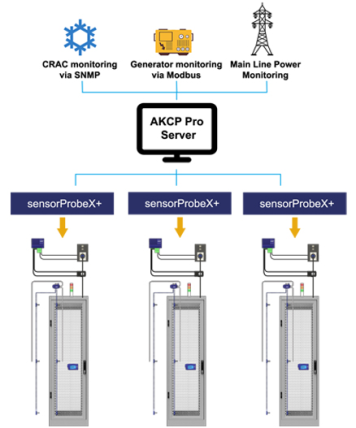
AKCPro Server is our world-class central monitoring and management software. Suitable for a wide range of monitoring applications. Monitor your infrastructure, whether it be a single building or a remote site over a wide geographic area. Integrate third-party devices with, Modbus, SNMP, and ONVIF-compatible IP cameras.
All data is collected and monitored through AKCPro Server central management software. This world-class DCIM software consolidates all your deployed hardware and virtual sensors into customizable dashboards. Features include:
- Drilldown mapping interface
- Modbus, SNMP, and PING virtual sensors (Licensed feature)
- Live PUE calculations
- Customizable desktops
- Access control management
- Centralized monitoring and management of sensors and base units.
- FREE for monitoring all AKCP devices
- ONVIF Camera integration (licensed feature)
From An Intelligent Rack to Data Center
Make adjustments to your data center environment, and instantly see the effect it has on PUE numbers. Run your data center at its optimum condition for cost savings and server health.
Benefits:
- Live PUE numbers
- Control and monitor CRAC units
- Thermal mapping of cabinets
- Integrated solution
- Control and monitor access to cabinets
- Control and monitor access to rooms
- Monitoring of complete power train
- Free DCIM software
Reference Links:
https://www.hpcwire.com/off-the-wire/qct-orqestra-management-tool-enables-hyperscale-monitoring-with-intuitive-gui/
https://www.embeddedcomputing.com/technology/ai-machine-learning/environmental-monitoring-for-hyperscale-data-centers
https://www.servertech.com/blog/the-role-of-environmental-monitoring-in-hyperscale-data-center
- About the Author
- Latest Posts
Nicholas Barrowclough( President )
For over two decades at AKCP, I have been focused on a single mission: bringing complete visibility, security, and efficiency to the world’s critical infrastructure.
I believe that in the modern data center, AI is only as good as the data it receives. My goal is to ensure facilities have the precise sensor facts needed to control AI opinions, ultimately reducing PUE, releasing stranded capacity, and ensuring maximum uptime.